Seen by Suniya
A handmade gifting brand where almost nothing ships as-is. The store had to sell by collection and by occasion, and collect the personalisation before the order was placed rather than after.
- E-commerce build
- Personalisation flow
- Occasion merchandising
- WhatsApp ordering
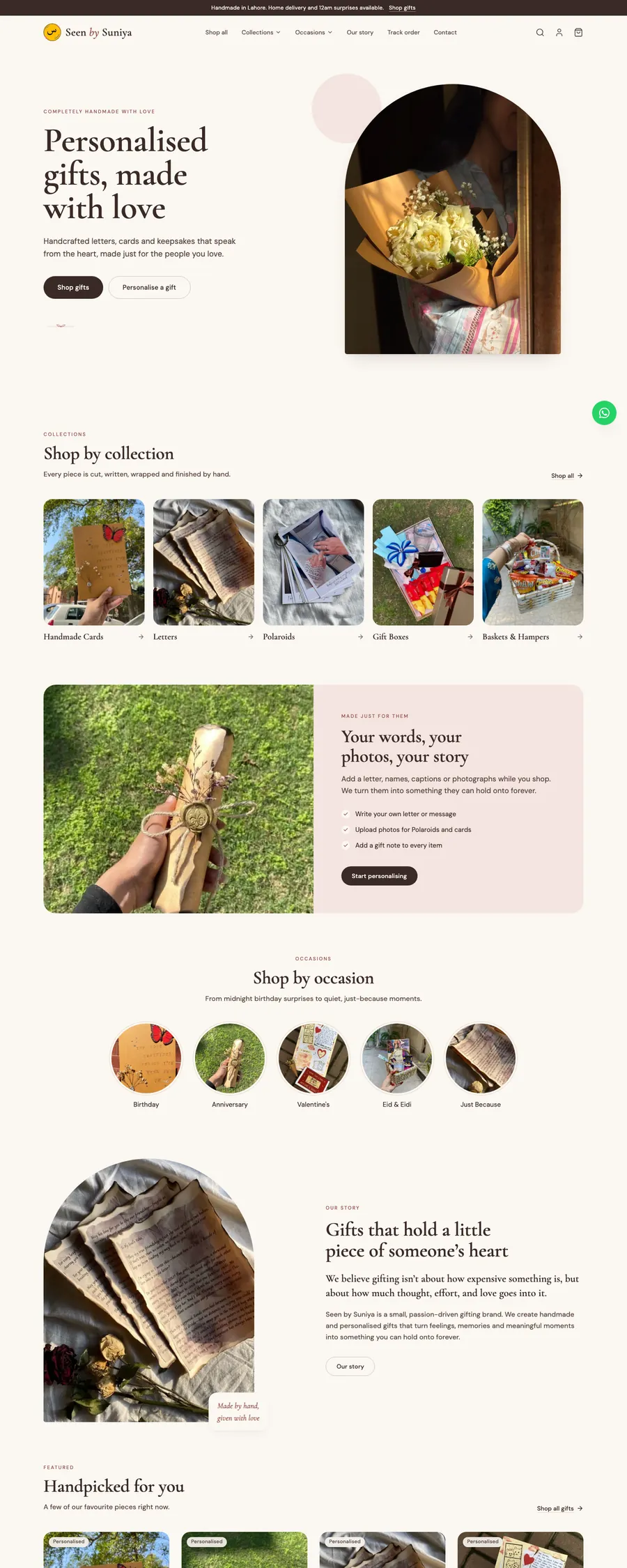
Gift buyers do not shop by product. They shop by moment.
Somebody buying a handmade letter is not comparing letters. They have a person, a date and a feeling, and they are looking for something that fits all three. A standard product grid is the wrong shape for that.
What the store had to do
- Merchandise twice over — by collection for people who know what they want, and by occasion for people who only know whose birthday it is.
- Make personalisation part of choosing the product, not an afterthought handled over chat.
- Take photo uploads without turning a phone camera file into a slow page for the next visitor.
- Carry the brand's handmade character without the heavy imagery making it feel slow.
- Keep WhatsApp one tap away, because gift buyers ask questions before they commit.
The thing that decides the build
Where the personalisation is captured. Collect it on the product page and the order arrives complete. Collect it afterwards and every sale starts a conversation — which is fine at five orders a week and unmanageable at fifty.
Two ways in, one checkout
Collections for the decided
Handmade cards, letters, Polaroids, gift boxes and baskets, each with its own landing page so a shopper who knows the format goes straight to it — and so each format can earn its own search traffic.
Occasions for the undecided
Birthday, anniversary, Valentine's, Eid and just-because, cutting across the collections. The same product appears in both routes, which is merchandising rather than duplication.
Personalisation on the product
Message, names and photo uploads sit with the item being bought, so the customisation is captured while the buyer is already thinking about it.
Uploads handled properly
Images are resized as they arrive and attached to the order line, so the maker sees the right photo against the right item and the storefront stays fast.
WhatsApp alongside, not instead
A persistent WhatsApp route for the questions that stop a purchase, without making chat the only way to order.
Making personalisation a product field rather than an order note. An order note is free text somebody has to interpret; a field is structured data that can be printed, checked and fulfilled without a conversation.
What is under it
| Layer | Choice | Why |
|---|---|---|
| Merchandising | Collections and occasions as parallel routes | Two different buyers, two different entry points, one catalogue underneath. |
| Personalisation | Structured fields on the product, not order notes | Fulfilment reads a form rather than interpreting a paragraph. |
| Media | Resize on upload, compressed product photography | Handmade goods need rich imagery, and rich imagery is the usual reason a gifting store is slow. |
| Conversation | WhatsApp as a standing channel | Gift buying generates questions. Removing that route costs orders. |
| Discovery | A page per collection and per occasion | Seasonal search is the whole game in gifting — “Eid gifts” needs a page, not a filter. |
Design the order, not just the storefront
A personalised product is only sold when the business knows exactly what to make. Everything before that is a quote.
About this project
Can you build a store where every product is customised?
Yes, and the important decision is where the customisation happens. Capturing the message, names and photos during the order — rather than chasing them over WhatsApp afterwards — is what stops personalised gifting turning into an admin job that grows with every sale.
Does personalisation slow the checkout down?
It can, which is why the fields appear on the product itself rather than as an extra step before payment. The customer is already deciding what to write while they choose; asking then costs nothing, asking later costs an order.
How do you handle photo uploads on a gifting store?
Uploads are attached to the order line, so the person making the item sees the right photo against the right product without digging through an inbox. Files are resized on upload so a phone photo does not slow the page down for the next visitor.
What about delivery deadlines for occasions?
Occasion-led stores live and die by cut-off dates. We build the collections around occasions and keep the cut-off messaging editable, so Valentine's or Eid timing can be changed by the owner in minutes rather than requested as a support ticket.
More ways we can help
Selling something made to order?
The harder the product is to standardise, the more the order flow matters. Tell us what you make.