TruxCRM
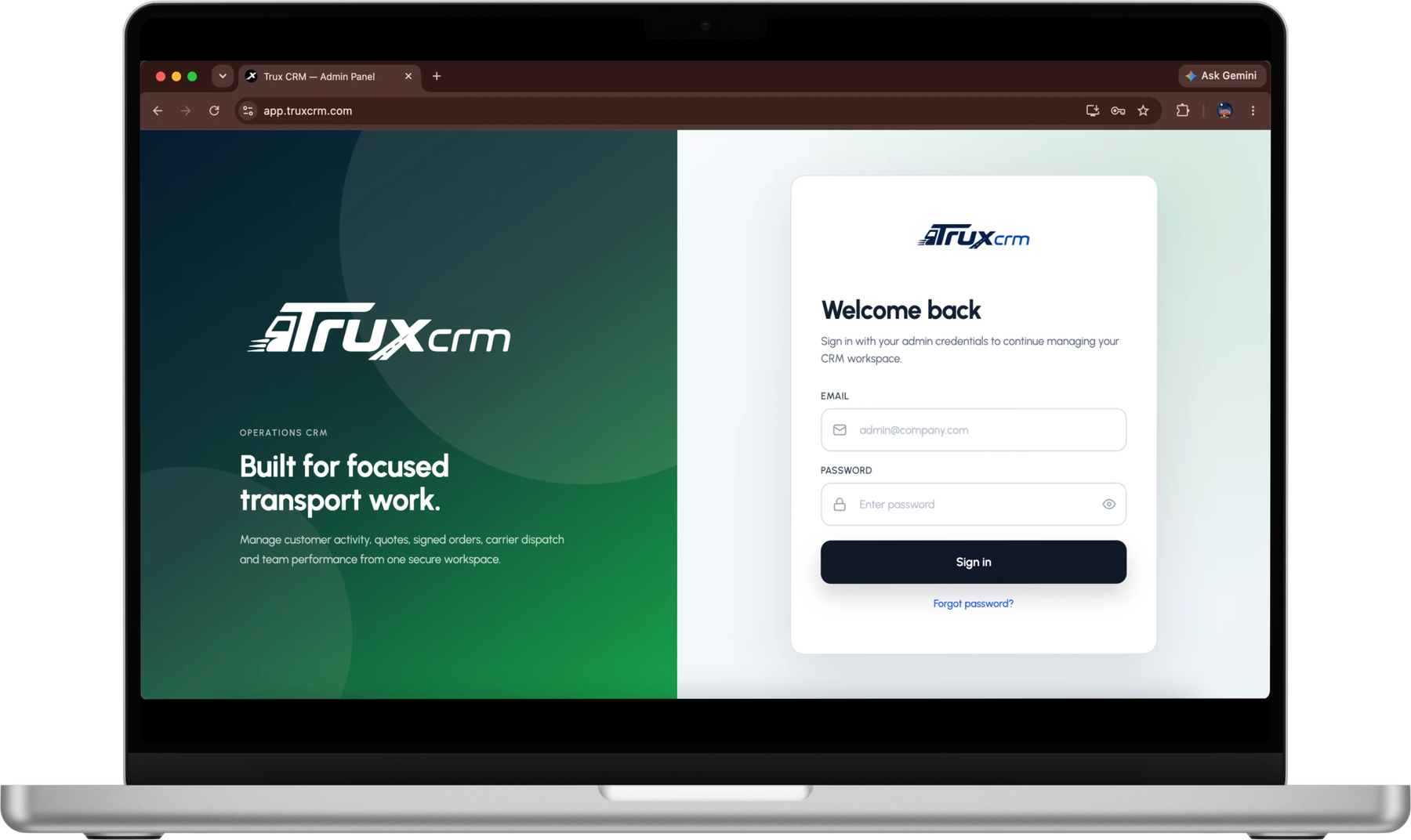
An operating platform for auto transport brokers, built and owned by GrowAx. One record carries a job from first lead to final delivery — quote, signed order, carrier, dispatch, invoice, payment, reconciliation.
- Multi-company SaaS
- Roles & permissions
- Billing
- Dispatch
- Reconciliation
A broker's job lives in six places at once
Auto transport brokerage is a coordination business. A single vehicle move touches a customer, a price, a signed order, a carrier, a driver, a pickup window, a delivery confirmation, an invoice and a payment — and in most brokerages each of those lives somewhere different.
Quotes in an inbox. Orders in a spreadsheet. Carrier details in someone's phone. Dispatch in a WhatsApp group. Invoices in accounting software that has never heard of the order. Payments reconciled by hand at the end of the month, badly.
Nothing here is complicated on its own. The cost is in the seams between them: the load nobody confirmed, the invoice raised against the wrong rate, the carrier who was called twice, the month-end that takes three days.
What we set out to build
- One record per job, carrying everything from first enquiry to reconciled payment.
- Company-scoped workspaces, so each brokerage's data is genuinely separate.
- Agent, dispatcher and owner roles with different views of the same job.
- Quoting that turns into a signed order without anyone retyping it.
- Invoicing and payment tracking attached to the order, not parked in another system.
- Reporting an owner can read on a phone without exporting anything.
Why this industry
Auto transport has a workflow specific enough that generic CRMs force brokers to work around them, and repeatable enough that one well-built product serves many companies. That combination is what makes an industry SaaS viable rather than a bespoke build with one customer.
The pieces that make it a platform, not a database
Company-scoped workspaces
Every brokerage gets its own space. Row-level security enforces the boundary in the database, not in the interface — which is the only place it actually counts.
Roles and permissions
Agents see their own pipeline, dispatchers see the board, owners see the company. One data model, three honest views.
Quote to signed order
A quote becomes an order with its terms intact. Nobody retypes a price, and the rate on the invoice is the rate that was agreed.
Carrier assignment and dispatch
Carrier records, assignment, pickup and delivery windows, and status changes that are visible to everyone who needs them at the same moment.
Invoicing and reconciliation
Invoices raised from the order, payments recorded against it, and a month-end that is a report rather than an archaeology project.
Reporting
Pipeline, agent performance, margin per job and outstanding payments — the four numbers an owner checks, available without an export.
Five things you only learn by owning the product
Schema decisions compound
A field you get wrong in week two becomes a migration in month fourteen. We now spend disproportionate time on the data model before anyone designs a screen — on client projects too.
Permissions are a product feature
“Who can see what” is not an admin detail. It determines whether a team trusts the system enough to put real data in it.
Billing is harder than the product
Proration, failed cards, mid-cycle upgrades, refunds, tax. Anyone quoting you a SaaS build without a serious line item for billing has not built one.
Support shapes the roadmap
Running our own support queue means feature priority comes from what people actually get stuck on, not from what sounds good in a planning meeting.
Boring reliability beats features
Users forgive a missing report. They do not forgive a dispatch board that was wrong for an hour. Uptime and correctness are the product.
The same method, a different workflow
If your sector runs on a workflow that spreadsheets and generic CRMs keep mangling, it is a candidate for the same treatment.
Map the real workflow
Not the one in the process document — the one your team actually performs, including the workarounds.
Find the record
Every industry platform has one object everything else hangs off. For TruxCRM it is the order. Finding yours is most of the design.
Build the narrow version
One workflow, done completely, in production, with real users — before adding the second.
Add the commercial layer
Accounts, plans, billing, onboarding. This is what turns an internal tool into a product you can sell.
About TruxCRM
Is TruxCRM available to buy?
Yes — it is sold per company on a subscription, with its own scoped workspace, agent accounts and reporting. The TruxCRM page has the detail.
Can you build something like TruxCRM for my industry?
That is exactly what TruxCRM proves we can do. We take an industry workflow and turn it into a multi-company subscription platform: accounts, roles, permissions, billing, dashboards, integrations and the operational reporting the business actually runs on.
Why does GrowAx build its own product at all?
Because running a product you sell teaches things client work never does — billing edge cases, security reviews, migrations, support at 2am, and the cost of a schema decision made eighteen months earlier. That experience goes straight back into client builds.
How long does a platform like this take?
A first production version of an industry platform is typically eight to twenty weeks depending on how much of the workflow is in scope. TruxCRM itself keeps evolving, because a product is never finished.
Got a workflow nobody has productised yet?
Tell us about it. We will tell you honestly whether it is a product or a spreadsheet that needs tidying.