St Albans Driving School
A driving school website that turns searches into booked lessons — lessons, intensive courses and test car rental laid out with pricing, reviews and a direct route to booking.
- Website design & development
- Local service SEO
- UK client
- Booking-led layout
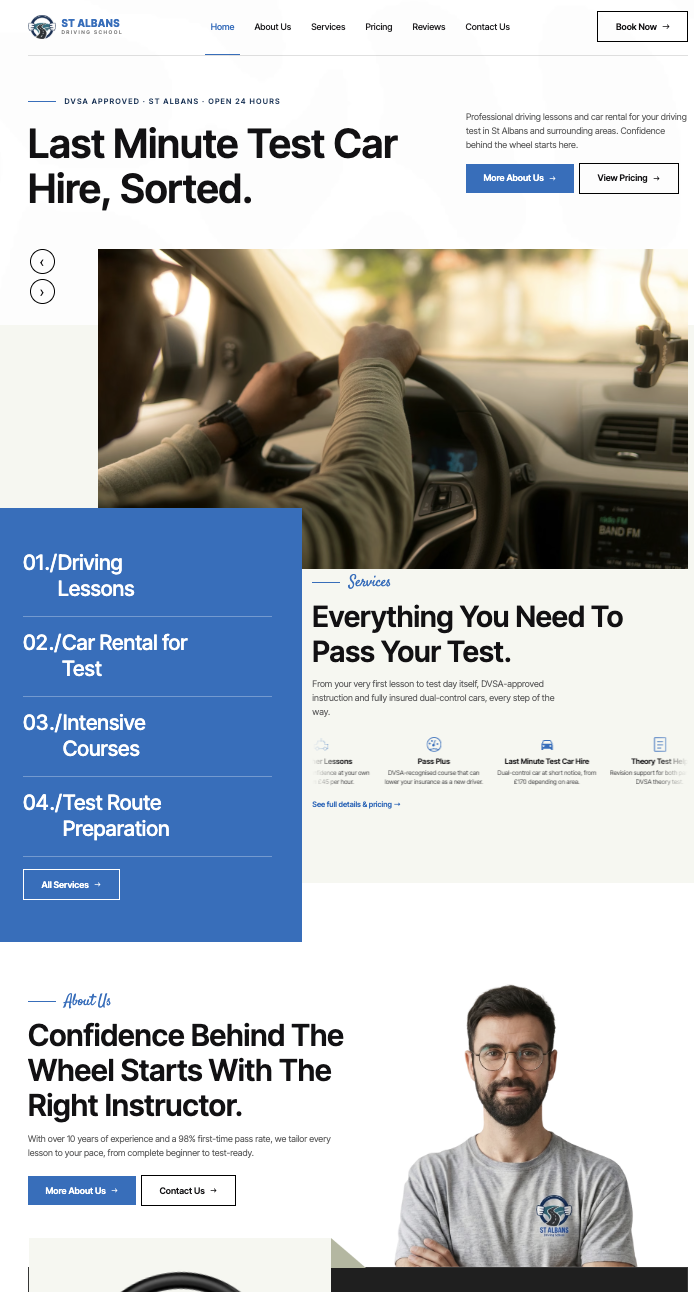
A learner decides in about ninety seconds
Someone searching for driving lessons is not browsing. They want to know three things: do you teach the kind of lesson I need, what does it cost, and can I book it now. Most driving school sites answer none of those above the fold.
What the site had to do
- Separate the offers properly — weekly lessons, intensive courses and test car rental are three different decisions, not one page.
- Publish pricing. A learner comparing schools will skip a site that hides the number behind a phone call.
- Put social proof next to the decision, not on a testimonials page nobody visits.
- Make booking a single obvious action on every screen, on a phone, with one thumb.
- Be findable for the specific searches learners actually type — automatic lessons, intensive course, test car hire, plus the area names around St Albans.
The core constraint
Local service search is decided by relevance and clarity far more than by design flourish. Every choice on this build was tested against one question: does this help a learner book faster, or does it just look nice?
Structure first, styling second
One page per decision
Weekly lessons, intensive courses and test car rental each got their own page with their own pricing, their own FAQs and their own booking path — so each one can rank for its own search, and so a learner never has to scroll past two offers they do not want.
Pricing in the open
Hourly rates, block-booking discounts and course prices published on the page. The enquiries that come in are better qualified because the price conversation already happened.
Reviews placed at the hesitation point
Social proof sits directly beside pricing and beside the booking button, which is where the doubt actually is — not parked on a separate page.
Mobile-first booking
Almost all of this traffic is on a phone. The booking action is reachable with a thumb from anywhere on the page, and the form asks for the minimum needed to start a conversation.
Local search structure
Titles, headings, schema and internal linking built around the lesson types and the areas served, with a Google Business Profile aligned to the same details.
Reordering the page so pricing appeared before the gallery. It is not a design decision anyone photographs, but it is the one that changes how many people reach the booking form.
What is under it
| Layer | Choice | Why |
|---|---|---|
| Front end | Hand-built responsive pages, no page-builder | Page-builder bloat is the single most common cause of a slow local-service site. Hand-built markup keeps Core Web Vitals in range on mid-range Android phones. |
| Content | One page per service, written for the searcher | A learner searching “intensive driving course” should land on a page about intensive courses — not a home page that mentions them in a list. |
| Structured data | LocalBusiness, Service and FAQ schema | Gives search engines the pricing, area and question data in a machine-readable form, which is what earns the richer result. |
| Conversion | Direct booking plus a short enquiry form | Two paths, because some learners want to book instantly and some want to ask one question first. |
| Measurement | Analytics events on every booking action | So the client can see which lesson type actually drives bookings, not just which page gets traffic. |
Design the decision, not the page
The site's job is not to describe a driving school. It is to get a nervous learner — or their parent — from a Google result to a booked first lesson without needing a phone call.
About this project
Do you work with UK businesses from Pakistan?
Yes. St Albans Driving School is a UK client. Work runs over email, WhatsApp and scheduled calls, with a staging link the client can open at any point. The five-hour time difference means feedback sent in the UK morning is usually actioned the same day.
Can you build a booking system into a site like this?
Yes — either a direct booking flow with payment, or a structured enquiry that lands in a CRM and gets routed to an instructor. Which one is right depends on whether availability is predictable enough to publish.
How do you approach a local service business in a competitive area?
Service pages built around the exact things people search — automatic lessons, intensive courses, test car hire — rather than one page listing everything. Then local signals: Google Business Profile, consistent details, reviews, and area coverage written honestly.
Run a local service business?
The same structure works for clinics, salons, gyms, academies and trades. Tell us what you sell.